How Prasenjit Sarma Is Blending AI, Empathy, and Access to Reimagine Learning
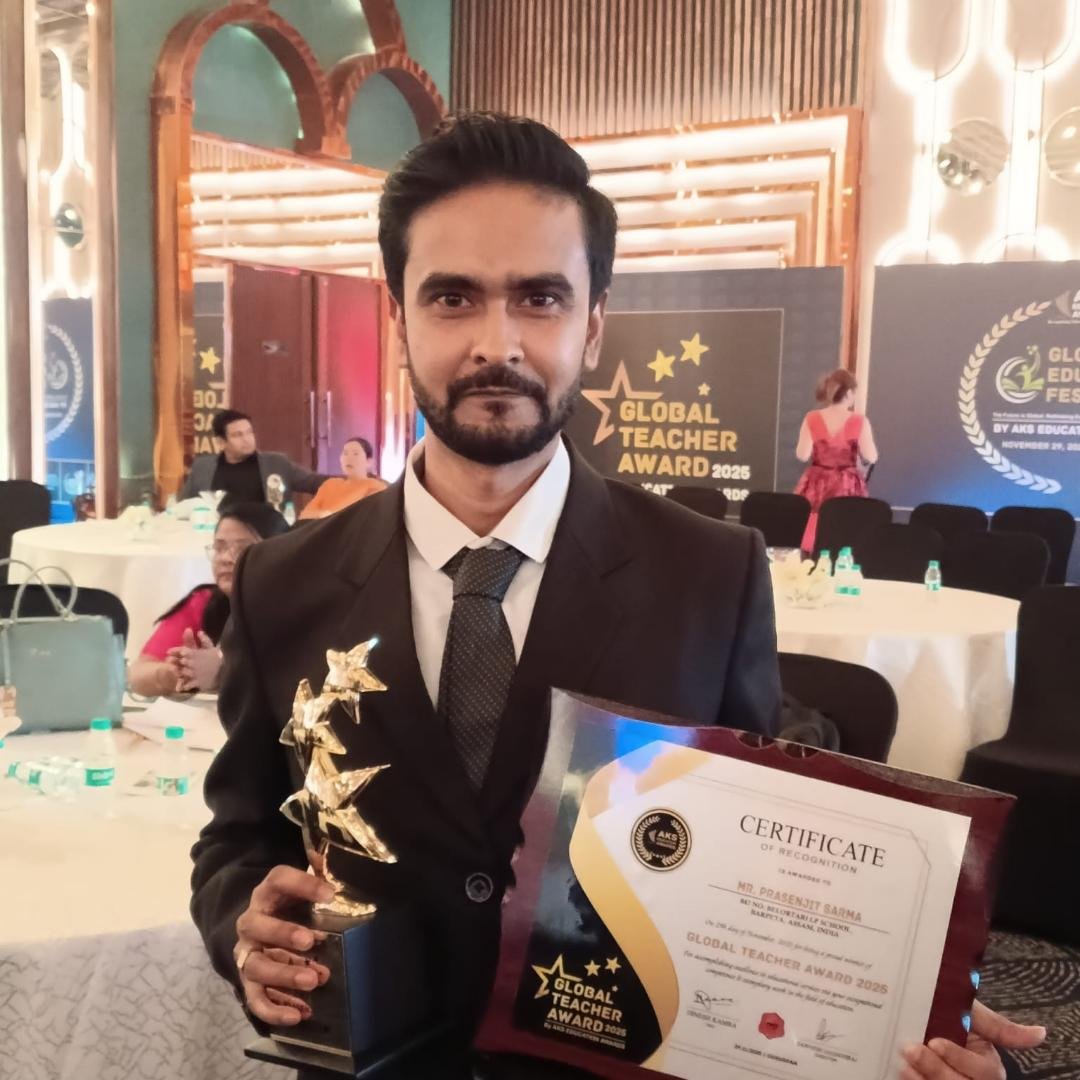
In a country where educational inequity often mirrors geography, Prasenjit Sarma is proving that world-class innovation can emerge far from traditional power centers. On November 29, 2025, at the Global Education Fest 2025–26 in New Delhi, Sarma received the Global Teacher Award 2025, an international recognition that capped a decade-long journey defined by ingenuity, social impact, and an unwavering focus on learners.
“Innovation in education does not require permission. It requires purpose.”
A Builder’s Mindset, Rooted in the Classroom
Sarma began his career in 2012 after qualifying Assam’s Teacher Eligibility Test, entering a public education system constrained by limited infrastructure and resources. Rather than accept the status quo, he adopted a builder’s mindset. In 2017, he created India’s first smart classroom for primary schools through crowdfunding, signaling a philosophy that would later define his work: impact first, scale later.
Scaling Impact With Artificial Intelligence
At the core of Sarma’s work is a pragmatic use of artificial intelligence, not as a buzzword, but as an equalizer. His AI-powered Lesson Plan Creator is now used by educators across the globe and generates more than 16,000 lesson plans every day.
Another flagship platform, AI Teacher, enables students to learn any subject anytime and anywhere. With more than 55 lakh learners reached globally, the platform reflects Sarma’s belief that access, not ability, is the biggest barrier to education.
Complementary tools like AI Proofreading Assistant, AI Writing Assistant, and the NIPUN Mitra AI Chatbot further extend this ecosystem, focusing on simplicity, usability, and real classroom needs. These platforms have been widely covered by Indian media and adopted by teachers and students well beyond the country’s borders.

“Technology should not replace teachers. It should amplify them.”
Leadership Beyond Technology
What distinguishes Sarma from many education technology innovators is his equal investment in systems and people. During the COVID-19 pandemic, he coordinated district-wide online classes across Barpeta district of Assam and led Utkarsh, a large-scale digital training initiative that enabled teachers to learn how to use ICT tools in education.
At the school level, initiatives such as Hanging Libraries, Hanging Gardens, BaLA Painting, Adarsh Avivawak Program, and Teachers’ Parliament demonstrate a holistic approach to learning that integrates environment, governance, parents, and student voice. These initiatives have been widely praised by national policy bodies including NITI Aayog, and have received extensive recognition across national and regional media platforms for their transformative impact on school ecosystems.
Author, Mentor, and Thought Leader
Sarma is also a prolific author. His works include a handbook on foundational literacy and numeracy learning outcomes, a textbook on Artificial Intelligence and Robotics for Classes IX and X, a guide on Child Psychology, and several pedagogical resources used by educators internationally.
Recognition That Reflects Momentum
The Global Teacher Award 2025 is the most visible milestone in a growing list of honors. In December, Sarma was awarded Best Teacher by Assam Down Town University. He is also a recipient of the Sewa Ratna Award 2024, the Best Teacher Award 2024 by PB Foundation, and numerous commendations from district administrations across Assam. Earlier this year, he was nominated for the National Teachers’ Award by the Government of India.
The Bigger Picture
Sarma’s story challenges a persistent narrative in global education. Innovation does not have to originate in elite institutions or technology hubs. It can begin in a government school classroom, scale through empathy and intelligent design, and reach millions across the world.
As education systems confront teacher shortages, learning gaps, and rapid digital transformation, Prasenjit Sarma’s work offers a compelling model: build for teachers, design for students, and scale with purpose.