
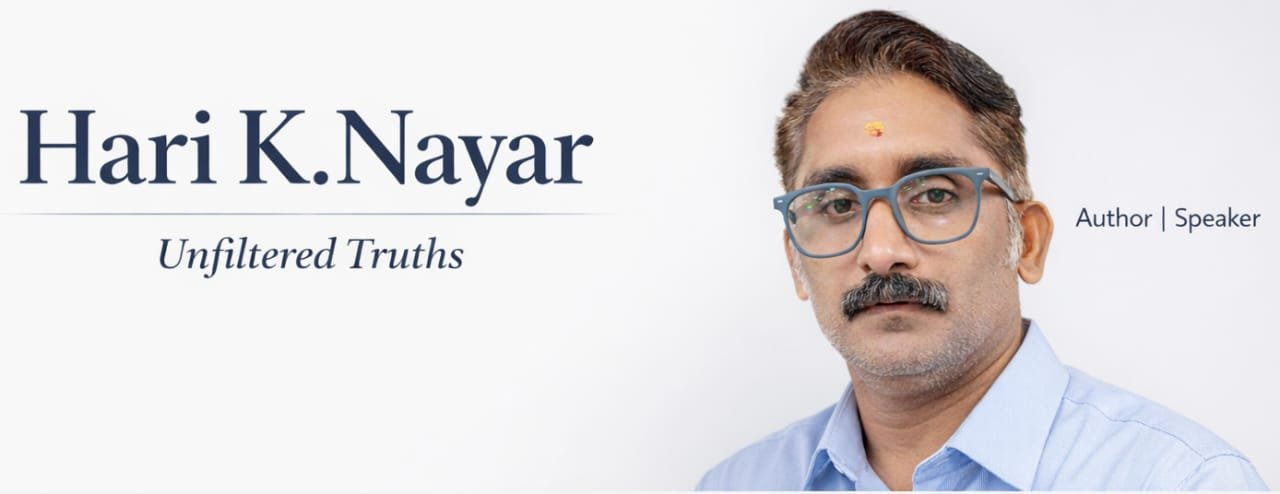
Author: Hari K. Nayar — Unfiltered Truths
Hari K. Nayar is a bold transformational thinker, author, and speaker who believes that real progress begins where comfort ends. With over 25 years of leadership experience across India, East Africa, and the Middle East, he brings a rare blend of business acumen, human insight, and moral clarity.
Known for speaking truth without fear and clarity without agenda, Hari challenges conditioned thinking around leadership, food consciousness, human behaviour, and societal hypocrisy. His work does not seek validation — it seeks awakening.
A results-driven business leader with deep expertise in operations, strategy, and people management, he is equally respected for his unfiltered perspectives on humanity, ethics, and long-term impact. His writings and talks question what most people avoid — not to provoke outrage, but to provoke thought.
Hari believes that silence in the face of truth is complicity, and that leadership is not about popularity, but responsibility.
“I don’t speak to please minds. I speak to awaken them.”
Goodreads (Author Profile): https://www.goodreads.com/author/show/22062289.Hari_Krishnan_Nair
YouTube – Unfiltered Truths (Primary Channel): https://www.youtube.com/@HariKNayar
YouTube (Content & Shares): https://share.google/S2o7qtM4Xd7F9Yilr
From Slaughter to Silence: Can Animal Stress Hormones Affect Human Behaviour?
Introduction: A Question Worth Asking
This article is not written to instruct anyone on what to eat or what to avoid. It is written to ask a deeper, often uncomfortable question:
Are we consuming only food, or are we also consuming fear?
In an age where conversations around mental health, anxiety, aggression, and emotional imbalance are becoming more common, it is worth exploring all possible contributors —
including those we rarely connect to the human mind: the emotional and hormonal state of animals at the moment they are turned into food.
This discussion is not religious, not ideological, and not intended to judge personal choices. It is an exploration of awareness, biology, ethics, and long-term human consequences.
The Moment Before Death: What Happens Inside an Animal
Consider a familiar scene in many parts of the world. A live chicken or animal is selected in a meat shop. The animal is alive, alert, and responsive. At some level — instinctive if not intellectual — animals sense threat and imminent danger.
Biology is clear about what happens next.
When an animal perceives danger or death, its body enters acute survival mode. This triggers a surge of stress-related hormones such as:
Cortisol (stress hormone)
Adrenaline and noradrenaline (fight-or-flight hormones)
Increased heart rate and blood circulation
This is not emotion-based speculation; it is basic mammalian physiology. Fear and stress are chemical events before they are emotional experiences.
In industrial or small-scale slaughter environments, this hormonal state is at its peak.
From Animal Body to Human Body
The next question is unavoidable:
What happens to those hormones after death?
They do not instantly disappear. They exist within the tissues, blood, and muscles of the animal.
Cooking may alter chemical structures, but it does not erase the biological history of the tissue.
When humans consume meat, they are not only consuming protein and fat — they are consuming biological material that once carried intense stress signals.
While modern science continues to study the extent of this impact, it is reasonable to ask whether long-term, repeated exposure to such stress-linked biological compounds:
Are we consuming only food, or are we also consuming fear?
In an age where conversations around mental health, anxiety, aggression, and emotional imbalance are becoming more common, it is worth exploring all possible contributors — including those we rarely connect to the human mind: the emotional and hormonal state of
animals at the moment they are turned into food.
This discussion is not religious, not ideological, and not intended to judge personal choices. It is an exploration of awareness, biology, ethics, and long-term human consequences.
The Moment Before Death: What Happens Inside an Animal
Consider a familiar scene in many parts of the world. A live chicken or animal is selected in a meat shop. The animal is alive, alert, and responsive. At some level — instinctive if not intellectual — animals sense threat and imminent danger.
Biology is clear about what happens next.
When an animal perceives danger or death, its body enters acute survival mode. This triggers a surge of stress-related hormones such as:
- Cortisol (stress hormone)
- Adrenaline and noradrenaline (fight-or-flight hormones)
- Increased heart rate and blood circulation
This is not emotion-based speculation; it is basic mammalian physiology. Fear and stress are chemical events before they are emotional experiences.
In industrial or small-scale slaughter environments, this hormonal state is at its peak.
From Animal Body to Human Body
The next question is unavoidable:
What happens to those hormones after death?
They do not instantly disappear. They exist within the tissues, blood, and muscles of the animal.
Cooking may alter chemical structures, but it does not erase the biological history of the tissue.
When humans consume meat, they are not only consuming protein and fat — they are consuming biological material that once carried intense stress signals.
While modern science continues to study the extent of this impact, it is reasonable to ask whether long-term, repeated exposure to such stress-linked biological compounds could influence the human endocrine and nervous systems.
Long-Term Human Effects: A Subtle Accumulation
Many people experience, especially with age:
- Heightened anxiety
- Sudden anger or irritation
- Emotional instability
- Restlessness and hyper-reactivity
- Mental fatigue without clear cause
These are often attributed solely to lifestyle, work pressure, or technology — and rightly so. But food is a daily, lifelong input, not an occasional influence.
If stress hormones can alter animal behaviour in seconds, it is reasonable to explore whether chronic dietary exposure could subtly influence human hormonal balance over decades.
This is not a claim of certainty. It is a call for expanded thinking.
Why Plant-Based Food Feels Different
Vegetables, fruits, grains, and legumes complete their life cycle without fear, chase, or violent interruption.
They grow through:
- Soil
- Water
- Sunlight
- Time
There is no acute stress response, no hormonal spike linked to survival panic.
Many people report feeling lighter, calmer, and mentally clearer when they move toward plant-based diets. While nutrition plays a role, the absence of fear-linked biological material may also be worth considering.
Food carries not just nutrients, but biological history.
Ancient Civilizations and the Use of Moral Boundaries
In ancient Indian civilization — distinct from modern religious identity — meat consumption was often discouraged or limited.
Was this only spiritual belief, or was it practical foresight?
Ancient societies understood population growth, ecological balance, and human appetite. They recognized that if killing became normalised purely for taste, species loss and ethical erosion would follow.
By attaching moral, spiritual, or karmic consequences, civilizations created psychological boundaries to protect life and sustainability.
Sometimes, symbolic fear was used to prevent real destruction.
The Evidence Around Us Today
Today we witness:
- Rapid species extinction
- Industrialized killing systems
- Desensitization to violence
- Rising mental health challenges
Humans no longer kill primarily to survive; we kill to satisfy preference.
That distinction matters.
This Is Not an Attack on Choice
This article does not condemn meat-eaters or elevate vegetarians as morally superior.
Choice matters. Culture matters. Circumstances matter.
But awareness matters most.
Eating consciously, understanding origins, and recognising long-term consequences is not extremism, it is responsibility.
Conclusion: From Slaughter to Silence
We often repeat the phrase, “You are what you eat.”
A deeper truth may be:
You become what you consume — biologically, hormonally, and emotionally.
A system built on repeated consumption of stressed life cannot expect only calm outcomes.
This is not about guilt. It is about reflection.
The future will not judge us by what we believed, but by what we preserved — in our bodies, our minds, and the world we leave behind.
“Food is not just fuel. It is memory, chemistry, and consequence”